
Hollywood's Most Unlucky Actors: The Stars Who Can't Escape Cancellation
Published 17.06.2025
You’ve moved to L.A. You booked the gig. You land the lead! But then the axe swings.
This is the streaming era for actors. Between 2020 and 2025, a brutal wave of cancellations swept through Netflix, Hulu, Prime Video, HBO, and Apple TV+.
In that time, 169 shows met an early end, sometimes before the season finale even aired. The real tragedy, however, was that for some actors, this wasn’t a one-time heartbreak. It became a trend.
In this report, we analyzed every cancelled streaming series (excluding mini-series or shows that wrapped naturally) across major platforms over the past five years. In total, 1,489 actors were involved but only 39 of them appeared in two or more doomed productions.
No matter how talented they might be, these are Hollywood’s most snakebitten.
The Most Unlucky
Michael Hsu Rosen and Melissa Fumero top the list as the only two actors to have starred in three canceled shows each. Not one. Not two. Three. All gone before finding their footing.
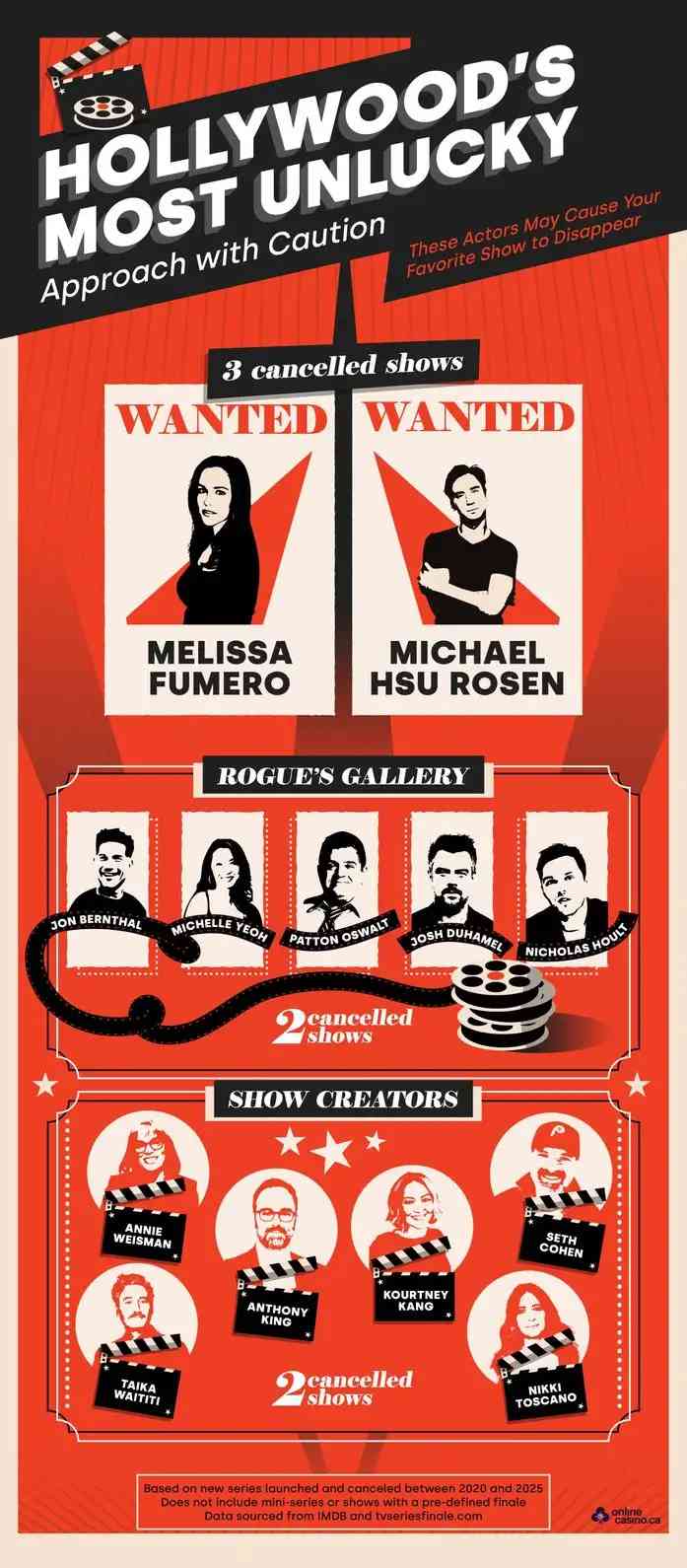
Fumero’s unlucky run includes M.O.D.O.K., Blockbuster, and Based on a True Story, a portfolio that covers animation, comedy, and dark thriller. None made it past a season. Meanwhile, Rosen starred in Glamorous, Tiny Pretty Things, and Pretty Smart, all of which were scrapped before they could even become cult favorites.
We ranked the 10 most unlucky actors not just by how many canceled shows they’ve been in, but also by how quickly those shows were axed. When ties occurred, we used average episodes per show as a tiebreaker. The thought here was that the fewer episodes your shows aired, the worse your bad luck.
Take Kaitlyn Dever, for instance, who went through only two canceled series (Monsterland, The Premise), but with an average of just two episodes per show.
Here are a few more heartbreakers from the top 10:
Teo Yoo (Dr. Brain, The Recruit): average 3.5 episodes
Jack Quaid (Vinyl, Lower Decks: The Shorts): versatile, talented, but still canceled
Jing Lusi (Gangs of London, Heart of Stone): both had promise, both got the axe
Across these 10 actors, the average number of episodes per canceled show was under 7, and most of these projects never made it past a first season.
So yes, talent doesn’t equal tenure. In fact, in the age of endless content, it might just mean getting cast in your next short-lived favorite.
When Fame Doesn’t Guarantee Survival
Think this is just happening to fresh faces? Think again. Streaming spares no one, not even the A-listers.
We found numerous examples of household name stars who couldn’t stop the cancellation clock:
Josh Duhamel (Jupiter’s Legacy, The Thing About Pam): major leading man energy, but both series fell flat
Michelle Yeoh (The Witcher: Blood Origin): was supposed to be a high-budget spinoff win, but…
John Cho (Cowboy Bebop): beloved IP, big fan expectations, one season and done
In the old days, star power could buy you time. Networks would ride things out, tweak the formula, and let audiences catch on. But in 2025’s content economy, fame is no longer a buffer. If the numbers don’t spike immediately, execs are quick to swing the scythe.
The Art of the Unfinished Series – Creators Who Can’t Catch a Break
While the actors face the spotlight, let’s not forget who’s behind the scenes. Some of the industry’s buzziest creators have seen their projects cut down just as fast.
Taika Waititi, the quirky darling behind What We Do in the Shadows and Thor: Ragnarok, wasn’t immune. His show Reservation Dogs gained critical acclaim but was quietly shuttered. The same happened to Time Bandits, his much-hyped Apple TV+ adaptation that never made it to series.
Other creators like David E. Kelley and Shonda Rhimes have seen both hits and misses. Kelley’s Big Sky was a success, but Goliath stumbled, and Rhimes made waves with Inventing Anna, but not enough to justify long-term renewal.
The lesson here is that even the most decorated showrunners in the business are learning that streaming is a battlefield.
So, Who Cancels the Most?
Let’s talk platform carnage.
Between 2020 and 2025, the five major streaming services, Netflix, Hulu, Prime Video, Peacock, and Apple TV+, all swung the axe. But some were *ahem* significantly more axe-happy than others.
Here's a quick peek at the body count:
Netflix: undisputed cancellation king, with over 60 shows axed in five years.
Hulu: surprisingly cutthroat at 14 shows canceled, especially with comedies and genre series
Amazon Prime: more patient than Netflix at around 22 canceled shows, but still ruthless when it comes to underperforming dramas
Peacock: hit the brakes on 16 shows, including the A-list Based on a True Story.
Apple TV+: fewer shows overall, but a relatively high cancellation rate proportionally at 14 canceled.
Netflix’s strategy has always been to throw everything at the wall and cancel what doesn’t immediately trend. It’s algorithmic Darwinism. Even buzz can’t save you if your completion rate is low.
If you’re an actor, getting cast on a Netflix original might feel like a career win… until the three-month mark hits and the renewal window slams shut.
The Cliffhanger Generation
For a business built on stories, streaming sure loves an unfinished one.
The actors on this list aren’t just unlucky, they’re canaries in the coal mine. Their careers tell the story of a system obsessed with instant gratification, short-term metrics, and ruthless pivots.
Unfortunately for fans, we’re left with half-baked plots, unresolved arcs, and that sinking feeling when the title card says “Season 1”… and nothing follows.
In this era, there’s no such thing as a guaranteed second season. And as this data proves, not even talent, star power, or fandom can protect you from becoming the next great show nobody gets to finish.
Methodology
To learn which actors and showrunners are the most “unlucky”, that is, those who have had the most shows canceled since 2020, we compiled a list of every show launched by the most popular streaming services and analyzed which services cancel the most shows. We also compiled cast and production rosters and examined which names appeared most frequently.
Fair Use
Interested in sharing this data? Feel free to use any of the information or graphics above for noncommercial purposes. Please be sure to provide linked attribution to this page in your article.